
“It ain’t what you don’t know that gets you into trouble. It’s what you know for sure that just ain’t so. — Attributed to Mark Twain.
Our need for certainty drives fragility
In times of uncertainty, we chase clarity and comfort. Any certainty will do. Most of our thinking is shaped by confirmation bias: we only see what supports our beliefs and ignore what doesn’t. That makes us vulnerable to manipulation, to kayfabe, to optic compliance and false assurance. Uncertainty itself is not dangerous, but our need for certainty is.
‘Doubt is not a weakness. It is a sign of intellectual integrity’ – Timothy Caulfield.
When we confuse uncertainty with threat, we tend to trade imagination for optimisation, exploration for execution, and curiosity for control. We give up freedom for conformity and mastery for metrics. And that makes that we don’t become more certain—we become more fragile.
We don’t know what we don’t know.
Why it is necessary to stay in the question
The real issue isn’t ignorance—it’s unknown unknowns. We assume we know, and stop asking. But the answer is the enemy of the question.
To move forward, we must:
- Ask more (and better) questions
- Accept we don’t have all the answers
- Get comfortable with discomfort, chronic unease.
Because in uncertainty lies freedom, possibility, and wisdom. Staying in the question is the key to long-term adaptability and success.
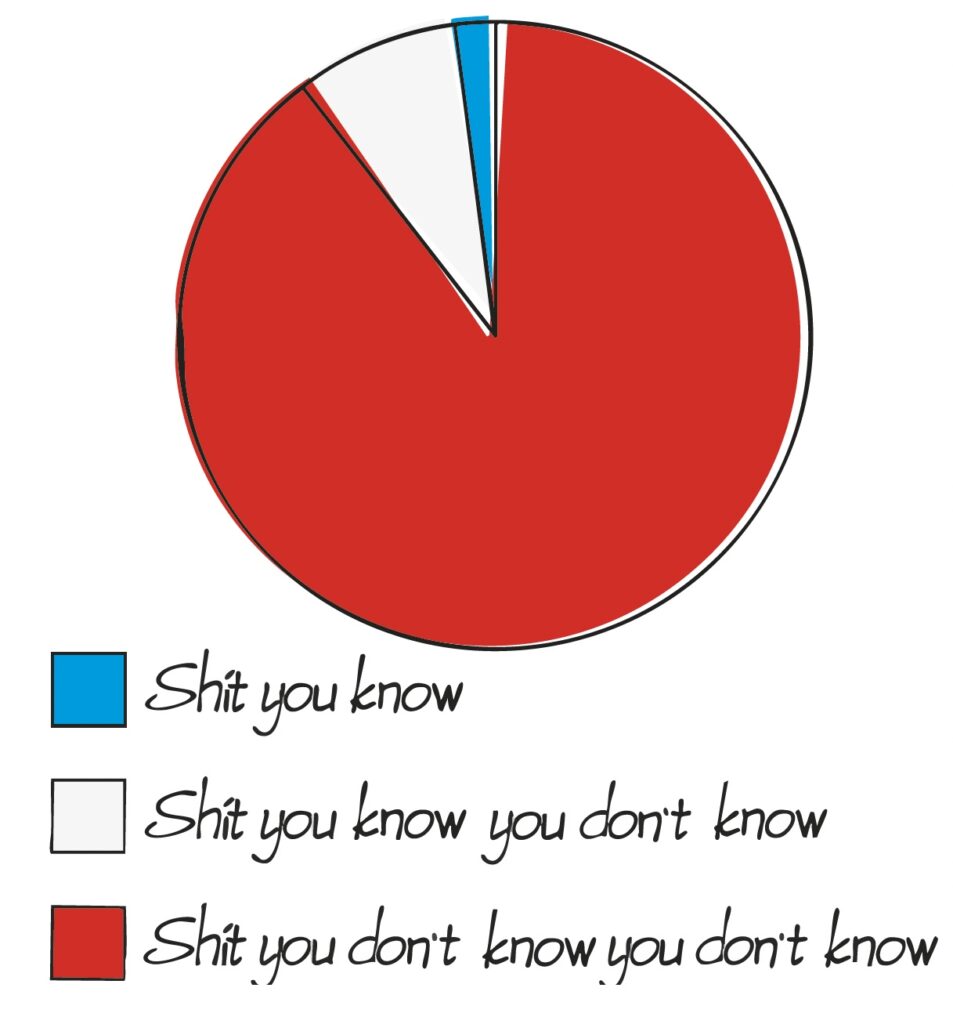
Embracing uncertainty is not about letting go of control. It’s about knowing when certainty helps us grow—and also when it limits us. It’s about embracing a wiser form of control.
Uncertainty is the path forward to more resilience
Embracing uncertainty is not a vague ideal. Is is a practical necessity. Not just for organisations, but for ourselves. We’ll explore what happens when we stop trying to eliminate uncertainty—and instead start working with it. What if uncertainty isn’t the problem?
Not knowing is a much better position than knowing. When you ‘know’ the answer you stop looking for better answers. You stop learning. And then surprises pop up.
We don’t fear uncertainty, but what it reveals about us
Most of us actually don’t fear uncertainty. We fear what it reveals about us: That we might not be prepared, That we might not have control, That we might be failing. We create plans, processes, and predictions to mask our fear. But – as Nuno Reis states – maybe we’re misunderstanding uncertainty altogether. We’ve built cultures allergic to the unknown. We confuse being on track with being alive. But breakthroughs, relationships, and insights are born from the unpredictable. By pathologising uncertainty, we lose our most human traits: curiosity, creativity and freedom. We exchange our questions for frameworks and checklists, our instincts for experts opinions. We outsource our thinking.
Man suffers most from the suffering he fears.
When we start noticing our deep curiosities and intuitions that never leave us. These are not flaws. These are signals. These are the thoughts you can’t explain, but also can’t ignore. Weak signals and early warnings. When you explore and follow them:
- Uncertainty becomes a creative force
- Confusion turns into curiosity
- Fear transforms into fuel
And that is where your Safety Jester may help you with and show you that there is no light at the end of the tunnel. He may show you that you are the light. Meaning: you have it all in your own hands. Your Safety Jester will help you in embracing uncertainty and take the red pill.

What really might help here is the power of wondering and imagination!
“The greatest obstacle to discovery is not ignorance — it is the illusion of knowledge”

Daniel J. Boorstin
Historian, scientist and author